On What Holiday Did the Green Knight Arrive to King Arthurs Court

A painting from the original manuscript of Sir Gawain and the Greenish Knight. The Greenish Knight is seated on the horse, holding upwards his severed head in his right hand.
The Dark-green Knight (Welsh: Marchog Gwyrdd, Cornish: Marghek Gwyrdh, Breton: Marc'heg Gwer) is a character from the 14th-century Arthurian verse form Sir Gawain and the Green Knight and the related medieval work The Greene Knight. His true proper name is revealed to be Bertilak de Hautdesert (an culling spelling in some translations is "Bercilak" or "Bernlak") in Sir Gawain, while The Greene Knight names him "Bredbeddle".[ane] The Green Knight afterward features as ane of Arthur's greatest champions in the fragmentary ballad "King Arthur and King Cornwall", again with the name "Bredbeddle".[2]
In Sir Gawain and the Dark-green Knight, Bertilak is transformed into the Dark-green Knight past Morgan le Fay, a traditional antagonist of King Arthur, in order to test his court.
Still, in The Greene Knight he is transformed by a unlike woman for the same purpose. In both stories he sends his wife to seduce Gawain equally a further examination. "King Arthur and King Cornwall" portrays him as an exorcist and ane of the well-nigh powerful knights of Arthur's courtroom.
In Sir Gawain, the Green Knight is so called considering his skin and clothes are green. The meaning of his greenness has puzzled scholars since the discovery of the poem.
Some place him as the Green Man, a vegetation existence of medieval fine art; others as a recollection of a figure from Celtic mythology; a heathen Christian symbol — the personified Devil. The medievalist C. S. Lewis said the graphic symbol was "equally vivid and physical equally any image in literature."[three] J. R. R. Tolkien called him the "most difficult graphic symbol" to interpret in the introduction to his edition of Sir Gawain and the Light-green Knight. His major role in Arthurian literature includes beingness a estimate and tester of knights, and as such the other characters consider him as friendly but terrifying and somewhat mysterious.[3]
Historical context [edit]
The primeval appearance of the Green Knight is in the late 14th century alliterative poem Sir Gawain and the Green Knight, which survives in only one manuscript forth with other poems by the same author, the so-called Pearl Poet.[4] This poet was a contemporary of Geoffrey Chaucer, writer of The Canterbury Tales, although the two wrote in different parts of England. The afterwards verse form, The Greene Knight, is a late medieval rhyming romance that likely predates its only surviving re-create: the 17th-century Percy Folio.[five] The other work featuring the Green Knight, the later ballad "King Arthur and King Cornwall", also survives only in the Percy Folio manuscript. Its date of limerick is conjectural; it may be a version of an earlier story, though information technology is also possibly a production of the 17th century.[6]
Part in Arthurian literature [edit]
In Sir Gawain and the Greenish Knight, the Green Knight appears before Arthur's court during a Christmas banquet, holding a bender of holly in one hand and a battle axe in the other. Despite disclaim of state of war, the knight issues a claiming: he volition allow one man to strike him in one case with his axe, with the condition that he return the blow the next twelvemonth. At showtime, Arthur accepts the challenge, simply Gawain takes his place and decapitates the Light-green Knight, who retrieves his head, reattaches it and tells Gawain to meet him at the Green Chapel at the stipulated time.[seven]
| No, I seek no battle, I assure y'all truly: |
| – The Greenish Knight addresses Arthur's Court in Sir Gawain and the Light-green Knight [8] |
The Knight features next every bit Bertilak de Hautedesert, lord of a large castle, Gawain'due south host before his arrival at the Green Chapel. At Bertilak's castle, Gawain is submitted to tests of his loyalty and guiltlessness, wherein Bertilak sends his wife to seduce Gawain and arranges that each fourth dimension Bertilak gains prey in hunting, or Gawain any gift in the castle, each shall exchange his proceeds for the other's. At New year's day'south Day, Gawain departs to the Dark-green Chapel,[vii] and bends to receive his blow, merely to take the Dark-green Knight feint two blows, then barely nick him on the third. He then reveals that he is Bertilak, and that Morgan le Fay had given him the double identity to examination Gawain and Arthur.
The Greene Knight tells the same story equally Sir Gawain and the Green Knight, with a few differences. Notably, the knight, here named "Bredbeddle", is simply wearing greenish, non light-green-skinned himself. The poem likewise states the knight has been asked past his married woman's female parent (not Morgan in this version) to play a joke on Gawain. He agrees because he knows his wife is secretly in love with Gawain, and hopes to deceive both. Gawain falters in accepting a girdle from her, and the Dark-green Knight's purpose is fulfilled in a small sense. In the finish, he acknowledges Gawain's ability and asks to accompany him to Arthur'southward court.
In King Arthur and King Cornwall, the Green Knight again features as Bredbeddle, and is depicted as one of Arthur's knights. He offers to help Arthur fight a mysterious sprite (controlled by the magician, King Cornwall) which has entered his chamber. When concrete attacks fail, Bredbeddle uses a sacred text to subdue information technology. The Green Knight somewhen gains so much control over the sprite through this text that he convinces it to take a sword and strike off its master's head.
Etymologies [edit]
The proper name "Bertilak" may derive from bachlach, a Celtic give-and-take meaning "churl" (i.e. rogueish, unmannerly), or from "bresalak", pregnant "contentious". The One-time French give-and-take bertolais translates as "Bertilak" in the Arthurian tale Merlin from the Lancelot-Grail Cycle of Arthurian fable. Notably, the 'Bert-' prefix ways 'bright', and the '-lak' can hateful either 'lake' or "play, sport, fun, etc". "Hautdesert" probably comes from a mix of both Old French and Celtic words meaning "High Wasteland" or "High Hermitage". It may too have an association with desirete meaning "disinherited" (i.e. from the Round Table).[3]
Similar or derivative characters [edit]
Green Knights in other stories [edit]

The Light-green Knight preparing to battle Sir Beaumains in N. C. Wyeth'southward illustration for Sidney Lanier'south The Male child'southward Rex Arthur: Sir Thomas Malory's History of Male monarch Arthur and His Knights of the Round Table (1922)
Characters similar to the Green Knight announced in several other works. In Thomas Malory's Le Morte d'Arthur, for example, Gawain's brother Gareth defeats 4 brothers in dissimilar coloured armour, including a "Grene Knyght" named Sir Partolope.[9] The 3 who survive the run into eventually join the Round Table and appear several further times in the text. The stories of Saladin feature a sure "Greenish Knight"; a Spanish warrior (maybe from Castile, co-ordinate to an Arab source) in a shield vert and a helmet adorned with stag horns. Saladin tries to make him role of his personal baby-sit.[10] Similarly, a "Chevalier Vert" appears in the Chronicle of Ernoul during the recollection of events following the capture of Jerusalem in 1187; here, he is identified as a Spanish knight who earned this nickname from the Muslims due to his eccentric wearing apparel.[11]
Some researchers[ who? ] have considered an association with Islamic tales. The figure of Al-Khidr (Arabic: الخضر) in the Qur'an is called the "Green Man" as the but man to have drunkard the water of life, which in some versions of the story turns him light-green.[12] He tests Moses three times by doing seemingly evil acts, which are somewhen revealed to be noble deeds to prevent greater evils or reveal great appurtenances. Both the Arthurian Green Knight and Al-Khidr serve as teachers to holy men (Gawain/Moses), who thrice tested their faith and obedience. Information technology has been suggested that the character of the Green Knight may be a literary descendant of Al-Khidr, brought to Europe with the Crusaders and composite with Celtic and Arthurian imagery.[13]
Characters fulfilling similar roles [edit]
The beheading game appears in a number of tales, the primeval being the Heart Irish tale Bricriu's Feast. The challenger in this story is named "Fear", a bachlach (boor), and is identified as Cú Roí (a superhuman male monarch of Munster in the Ulster Wheel of Irish mythology) in disguise. He challenges three warriors to his game, but to accept them run from the return blow, until the hero Cú Chulainn accepts the challenge. With Cú Chulainn under his axe, this antagonist as well feints three blows earlier letting the hero go. In the Irish version, the cloak of the churl is described equally glas, which means green.[fourteen] In the Life of Caradoc, a Middle French narrative embedded in the anonymous First Continuation of Chrétien de Troyes' Perceval, the Story of the Grail, another similar challenge is issued. In this story, a notable divergence is that Caradoc's challenger is his male parent in disguise, come to test his honour. The French romances La Mule sans frein and Hunbaut and the Middle High High german epic poem Diu Crone feature Gawain in beheading game situations. Hunbaut furnishes an interesting twist: Gawain cuts off the homo's head, and then pulls off his magic cloak before he can replace it, causing his death.[15] A similar story, this time attributed to Lancelot, appears in the 13th century French work Perlesvaus.
The 15th-century The Turke and Gowin begins with a Turk entering Arthur's courtroom and asking, "Is in that location whatsoever will, every bit a blood brother, To requite a buffett and take another?"[16] Gawain accepts the claiming, and is and so forced to follow the Turk until he decides to return the blow. Through the many adventures they have together, the Turk, out of respect, asks the knight to cutting off the Turk'south head, which Gawain does. The Turk, surviving, then praises Gawain and showers him with gifts. Sir Gawain and the Carle of Carlisle contains a scene in which the Carl, a lord, orders Gawain to strike him with his spear, and bends over to receive the accident.[17] Gawain obliges, the Carl rises, laughing and unharmed, and, dissimilar in Sir Gawain and the Light-green Knight, no render blow is demanded or given.[15] Among all these stories, Sir Gawain and the Green Knight is the only i with a completely light-green character, and the simply one tying Morgan le Fay to his transformation.[xv] [sixteen]
Several stories also feature knights struggling to stave off the advances of voluptuous women, including Yder, the Lancelot-Grail Cycle, Hunbaut, and The Knight of the Sword. The Dark-green Knight parallel in these stories is a King testing a knight as to whether or not he will remain celibate in extreme circumstances. The woman he sends is sometimes his married woman (every bit in Yder), if he knows that she is unfaithful and will tempt other men; in The Knight of the Sword the rex sends his cute girl. All characters playing the Green Knight's function kill unfaithful knights who neglect their tests.[15]
Significance of the color light-green [edit]
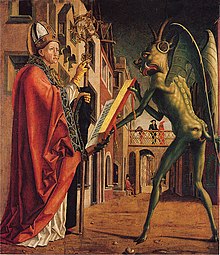
Michael Pacher'due south painting of a green Devil with Saint Augustine in 1475. This imagery is modelled after the Gawain verse form. Poetic contemporaries such equally Chaucer also made associations between the colour light-green and the devil, causing scholars to make similar associations in readings of the Dark-green Knight.[eighteen]
In English folklore and literature, greenish has traditionally been used to symbolise nature and its embodied attributes, namely those of fertility and rebirth. Critics take claimed that the Light-green Knight'southward role emphasises the environment exterior of human dwelling house.[nineteen] With his alternate identity as Bertilak, the Green Knight tin likewise exist seen equally a compromise between both humanity and the surround as opposed to Gawain's representation of human civilisation.[20] Oftentimes it is used to embody the supernatural or spiritual other world. In British folklore, the devil was sometimes considered to exist green which may or may not play into the concept of the Green Man/ Wild Human being dichotomy of the Green Knight.[21] Stories of the medieval period also portray the colour as representing dear and the amorous in life,[22] and the base of operations, natural desires of homo.[23] Green is also known to have signified witchcraft, devilry and evil for its association with the fairies and spirits of early English folklore and for its association with decay and toxicity.[24] The colour, when combined with gold, is sometimes seen every bit representing the fading of youth.[25] In the Celtic tradition, green was avoided in article of clothing for its superstitious clan with misfortune and death. Dark-green can be considered in Sir Gawain and the Green Knight as signifying a transformation from proficient to evil and back once more; displaying both the spoiling and regenerative connotations of the colour.[3] [xviii] Given these varied and even contradictory interpretations of the color green, its precise meaning in the poem remains ambiguous.
Interpretations [edit]
Of the many characters like to him, the Dark-green Knight of Sir Gawain is the first to exist green.[26] Because of his strange colour, some scholars believe him to be a manifestation of the Green Man figure of medieval art,[3] or as a representation of both the vitality and fearful unpredictability of nature. That he carries a green holly branch, and the comparison of his beard to a bush-league, has guided many scholars to this interpretation. The gilt entwined in the textile wrapped effectually his axe, combined with the green, gives him both a wild and an aloof air.[23] Others consider him as beingness an incarnation of the Devil.[3] In one estimation, it is thought that the Light-green Knight, equally the "Lord of Hades", has come to challenge the noble knights of King Arthur'southward courtroom. Sir Gawain, the bravest of the knights, therefore proves himself equal to Hercules in challenging the Knight, tying the story to aboriginal Greek mythology.[24] Scholars like Curely merits the descriptive features of the Greenish Knight propose a servitude to Satan such equally the beaver-hued beard alluding to the emblematic significance of beavers for the Christian audience of the time who believed that they renounced the world and paid "tribute to the devil for spiritual freedom."[27] Another possible interpretation of the Dark-green Knight views him equally combining elements from the Greek Hades and the Christian Messiah, at once representing both skilful and evil and life and decease as cocky-proliferating cycles. This interpretation embraces the positive and negative attributes of the colour green and relates to the enigmatic motif of the poem.[3] The description of the Greenish Knight upon his archway to Arthur's Court every bit "from neck to loin… potent and thickly made" is considered by some scholars as homoerotic.[28]
C.S. Lewis declared the Green Knight "as vivid and physical as any image in literature" and further described him as:
a living coincidentia oppositorum; half giant, yet wholly a "lovely" knight"; as full of demoniac energy as old Karamazov, yet in his own firm, every bit jolly equally a Dickensian Christmas host; now exhibiting a ferocity and then gleeful that it is most genial, and now a geniality so outrageous that it borders on the ferocious; half boy or buffoon in his shouts and laughter and jumpings; however at the end judging Gawain with the tranquil superiority of an angelic being [29]
The Green Knight could likewise be interpreted as a blend of two traditional figures in romance and medieval narratives, namely, "the literary dark-green human being" and the "literary wild man."[xxx] "The literary green human" signifies "youth, natural vitality, and love," whereas the "literary wild human" represents the "hostility to knighthood," "the demonic" and "death." The Knight'southward green pare connects the light-green of the costume to the light-green of the hair and beard, thus connecting the dark-green man'south pleasant manners and significance into the wild man'south grotesque qualities.[thirty]
Jack in the green [edit]
The Light-green Knight is also compared to the English holiday effigy Jack in the green. Jack is part of a May Day holiday tradition in some parts of England, only his connectedness to the Knight is constitute mainly in the Derbyshire tradition of Castleton Garland. In this tradition, a kind of Jack in the greenish known as the Garland Rex is led through the boondocks on a horse, wearing a bell-shaped garland of flowers that covers his entire upper body, and followed by immature girls dressed in white, who trip the light fantastic at various points along the route (formerly the boondocks'southward bellringers, who still make the garland, also performed this role). On the tiptop of the Male monarch's garland is the "queen", a posy of bright flowers. The Rex is also accompanied by his elegantly dressed female consort (present, confusingly, also known every bit the Queen); played by a woman during recent times, until 1956 "the Woman" was e'er a man in woman's clothing. At the stop of the anniversary, the queen posy is taken off the garland, to be placed on the boondocks's state of war memorial. The Garland Male monarch and so rides to the church belfry where the garland is hauled upward the side of the tower and impaled upon a pinnacle.[31] Due to the nature imagery associated with the Dark-green Knight, the ceremony has been interpreted equally possibly deriving from his famous beheading in the Gawain verse form. In this example, the posy'southward removal would symbolise the loss of the knight's head.[32]
Greenish Chapel [edit]
In the verse form Gawain, when the Knight is beheaded, he tells Gawain to meet him at the Green Chapel, saying that all nearby know where it is. Indeed, the guide which is to bring Gawain there from Bertilak'southward castle grows very fearful as they almost information technology and begs Gawain to turn back. The terminal meeting at the Light-green Chapel has caused many scholars to depict religious connections, with the Knight fulfilling a priestly role with Gawain equally a penitent. The Greenish Knight ultimately, in this interpretation, judges Gawain to be a worthy knight, and lets him live, playing a priest, God, and judge all at once.
The chapel is considered by Gawain as an evil place: foreboding, "the most accursed church", "the identify for the Devil to recite matins"; simply when the mysterious Knight allows Gawain to live, Gawain immediately assumes the office of penitent to a priest or judge, equally in a 18-carat church. The Dark-green Chapel may also be related to tales of fairy hills or knolls of earlier Celtic literature. Some scholars have wondered whether "Hautdesert" refers to the Green Chapel, equally it means "High Hermitage"; simply such a connection is doubted past most scholars.[iii] Equally to the location of the chapel, in the Greene Knight poem, Sir Bredbeddle'due south living place is described as "the castle of hutton", causing some scholars to advise a connection with Hutton Manor House in Somerset.[33] Gawain'southward journey leads him directly into the eye of the Pearl Poet's dialect region, where the candidates for the locations of the Castle at Hautdesert and the Green Chapel stand. Hautdesert is thought to exist in the area of Swythamley in northwest Midland, equally it is in the writer's dialect area, and matches the state features described in the verse form.[34] The Green Chapel is thought to exist in either Lud'due south Church building or Wetton Mill, as these areas closely lucifer the descriptions given past the author.[35] Ralph Elliott for example located the chapel the knight searches for well-nigh ( "two myle henne" v1078) the erstwhile estate firm at Swythamley Park at the lesser of a valley ( "bothm of the brem valay" v2145) on a hillside ( "loke a littel on the launde, on thi lyfte honde" v2147) in a large fissure ( "an olde caue,/or a creuisse of an olde cragge" v2182–83).[36]
See besides [edit]
- Listing of Arthurian characters
- Gawain (opera)
- The Green Knight (film)
Notes [edit]
- ^ Hahn, Thomas. "The Greene Knight". In Sir Gawain: Eleven Romances and Tales, p. 314. Western Michigan University Medieval Constitute Publications. (2000) ISBN one-879288-59-1.
- ^ Hahn, Thomas. "Male monarch Arthur and King Cornwall". In Sir Gawain: Eleven Romances and Tales, p. 427. Western Michigan University Medieval Institute Publications. (2000) ISBN 1-879288-59-ane.
- ^ a b c d due east f one thousand h Besserman, Lawrence. "The Idea of the Green Knight." ELH, Vol. 53, No. ii. (Summer, 1986), pp. 219–239. The Johns Hopkins University Printing.
- ^ Scattergood, Vincent J. "Sir Gawain and the Dark-green Knight". In Lacy, Norris J. (Ed.), The New Arthurian Encyclopedia, p. 419–421. New York: Garland. (1991). ISBN 0-8240-4377-4.
- ^ Hahn, Thomas. "The Orangish Knight". In Sir Gawain: Eleven Romances and Tales, pp. 309–312. Western Michigan University Medieval Institute Publications. (2000). ISBN 1-879288-59-1.
- ^ Hahn, Thomas. "King Arthur and King Cornwall". In Sir Gawain: Eleven Romances and Tales, pp. 419–421. Western Michigan University Medieval Constitute Publications. (2000). ISBN 1-879288-59-1.
- ^ a b Wilhelm, James J. "Sir Gawain and the Green Knight." The Romance of Arthur. Ed. Wilhelm, James J. New York: Garland Publishing, 1994. 399 – 465.
- ^ "Sir Gawain and the Green Knight." The Broadview Anthology of British Literature: The Medieval Catamenia. Vol. 1. ed. Joseph Black, et al. Toronto: Broadview Press. ISBN 1-55111-609-X Intro pg. 235
- ^ Malory, Thomas; Vinaver, Eugène. Malory: Consummate Works. p. 185. Oxford University Press. (1971). ISBN 978-0-19-281217-9.
- ^ Richard, Jean. "An Account of the Battle of Hattin Referring to the Frankish Mercenaries in Oriental Moslem States" Speculum 27.2 (1952) pp. 168–177.
- ^ See the "Chronique d'Ernoul et de Bernard le Trésorier", edited by L. de Mas Latrie, Paris 1871, p. 237.
- ^ Ng, Su Fang, and Kenneth Hodges. "Saint George, Islam, and Regional Audiences in 'Sir Gawain and the Green Knight.'" Studies in the Age of Chaucer, vol. 32, 2010, pp. 256
- ^ Lasater, Alice E. Spain to England: A Comparative Study of Standard arabic, European, and English Literature of the Middle Ages. University Press of Mississippi. (1974). ISBN 0-87805-056-vi.
- ^ Buchanan, Alice (1932). "The Irish Framework of Gawain and the Green Knight". PMLA. 47 (2): 315–338. doi:ten.2307/457878. JSTOR 457878.
- ^ a b c d Brewer, Elisabeth. Sir Gawain and the Green Knight: sources and analogues. second Ed. Boydell Press. (November 1992) ISBN 0-85991-359-vii
- ^ a b Hahn, Thomas. "The Turke and Sir Gawain". In Sir Gawain: 11 Romances and Tales. Western Michigan University Medieval Institute Publications. (2000) ISBN 1-879288-59-ane. Online: The Turke and Sir Gawain.
- ^ Hahn, Thomas. "Sir Gawain and the Carle of Carlisle". In Sir Gawain: 11 Romances and Tales. Western Michigan University Medieval Institute Publications. (2000). ISBN 1-879288-59-1. Online: Sir Gawain and the Carle of Carlisle.
- ^ a b Robertson, D. W. Jr. "Why the Devil Wears Greenish." Modern Language Notes (November 1954) 69.seven pgs. 470–472
- ^ George, Michael W. "Gawain's Struggle with Ecology: Attitudes toward the Natural Globe in Sir Gawain and the Green Knight" 'The Journal of Ecocriticism, vol. ii, no. 2, 2010. pg. 37
- ^ George, "Natural World," pg. 39
- ^ Krappe, A.H. "Who Was the Green Knight?" Speculum 13.ii (1938): 206–215.
- ^ Chamberlin, Vernon A. "Symbolic Greenish: A Time-Honored Characterizing Device in Castilian Literature." Hispania Vol. 51, No. i (Mar. 1968), pp. 29–37
- ^ a b Goldhurst, William. "The Green and the Aureate: The Major Theme of Gawain and the Light-green Knight." College English, Vol. 20, No. 2 (Nov. 1958), pp. 61–65
- ^ a b Williams, Margaret. The Pearl Poet, His Complete Works. Random House, 1967.
- ^ Lewis, John Southward. "Gawain and the Green Knight." College English. Vol. 21, No. ane (Oct. 1959), pp. 50–51
- ^ Krappe, A. H. "Who Was the Greenish Knight?" Speculum. (April 1938) 13.two pgs. 206–215
- ^ Curley, Michael J. "A Note of Bertilak's Bristles." Modern Philology, vol. 73, no.1, 1975, pp.70
- ^ Zeikowitz, Richard E. "Befriending the Medieval Queer: A Instruction for Literature Classes" College English language Special Result: Lesbian and Gay Studies/Queer Pedagogies. 65.1 (2002) 67–80.
- ^ "The Anthropological Approach," in English language and Medieval Studies Presented to J.R.R. Tolkien on the Occasion of His Seventieth Altogether, ed. Norman Davis and C.L. Wrenn (London: Allen and Unwin, 1962), 219–xxx; reprinted in Critical Studies of Sir Gawain and the Dark-green Knight, ed. Donald R. Howard and Christian Zacher (Notre Dame, Ind. and London: Univ. of Notre Dame Press, 1968), 63.
- ^ a b Larry D. Benson, Fine art and Tradition in Sir Gawain and the Green Knight (New Brunswick: Rutgers Univ. Press, 1965), 56–95
- ^ Pigsty, Christina. "A Dictionary of British Folk Customs." Paladin Books/Granada Publishing (1978) 114–115
- ^ Rix, Michael M. "A Re-Examination of the Castleton Garlanding." Folklore (June 1953) 64.two pgs. 342–344
- ^ Wilson, Edward. "Sir Gawain and the Green Knight and the Stanley Family of Stanley, Storeton, and Hooton." The Review of English language Studies. (August 1979) 30.119 pgs. 308–316
- ^ Twomey, Michael. "Hautdesert". Travels With Sir Gawain. Ithaca Univ. Retrieved 21 June 2007.
- ^ Twomey, Michael. "The Dark-green Chapel". Travels With Sir Gawain. Ithaca Univ. Retrieved 21 June 2007.
- ^ Elliott, R. W. Five. (2010). "Searching for the Green Chapel". In Lloyd Jones, J. Yard. (ed.). Chaucer's Landscapes and Other Essays. Melbourne: Aust. Scholarly Publishing. pp. 293–303.
External links [edit]
- Text of The Greene Knight
- Text of King Arthur and King Cornwall
carpenterinny1939.blogspot.com
Source: https://en.wikipedia.org/wiki/Green_Knight
0 Response to "On What Holiday Did the Green Knight Arrive to King Arthurs Court"
Enregistrer un commentaire